

What candidate fraud looks like now
Fraud runs on a spectrum, from a real person exaggerating with AI help to a person who doesn't exist at all. Most of what you'll see sits at the mild end; the dangerous cases sit at the far end and are rarer, but costlier.
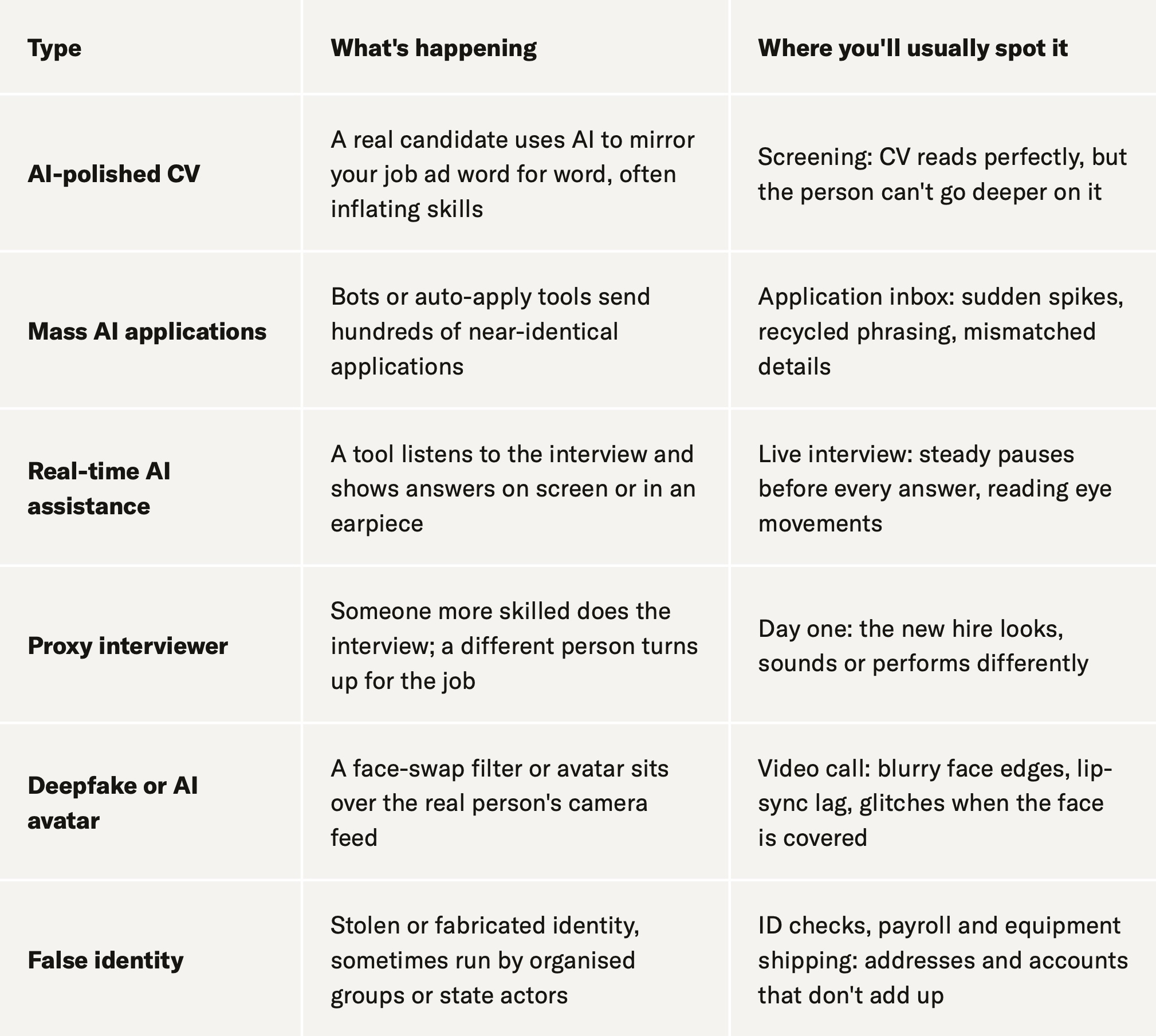
The first two are mostly a quality and volume problem. The last four are a trust and security problem, and that's where this guide spends most of its time.
Deepfakes and camera tricks in video interviews
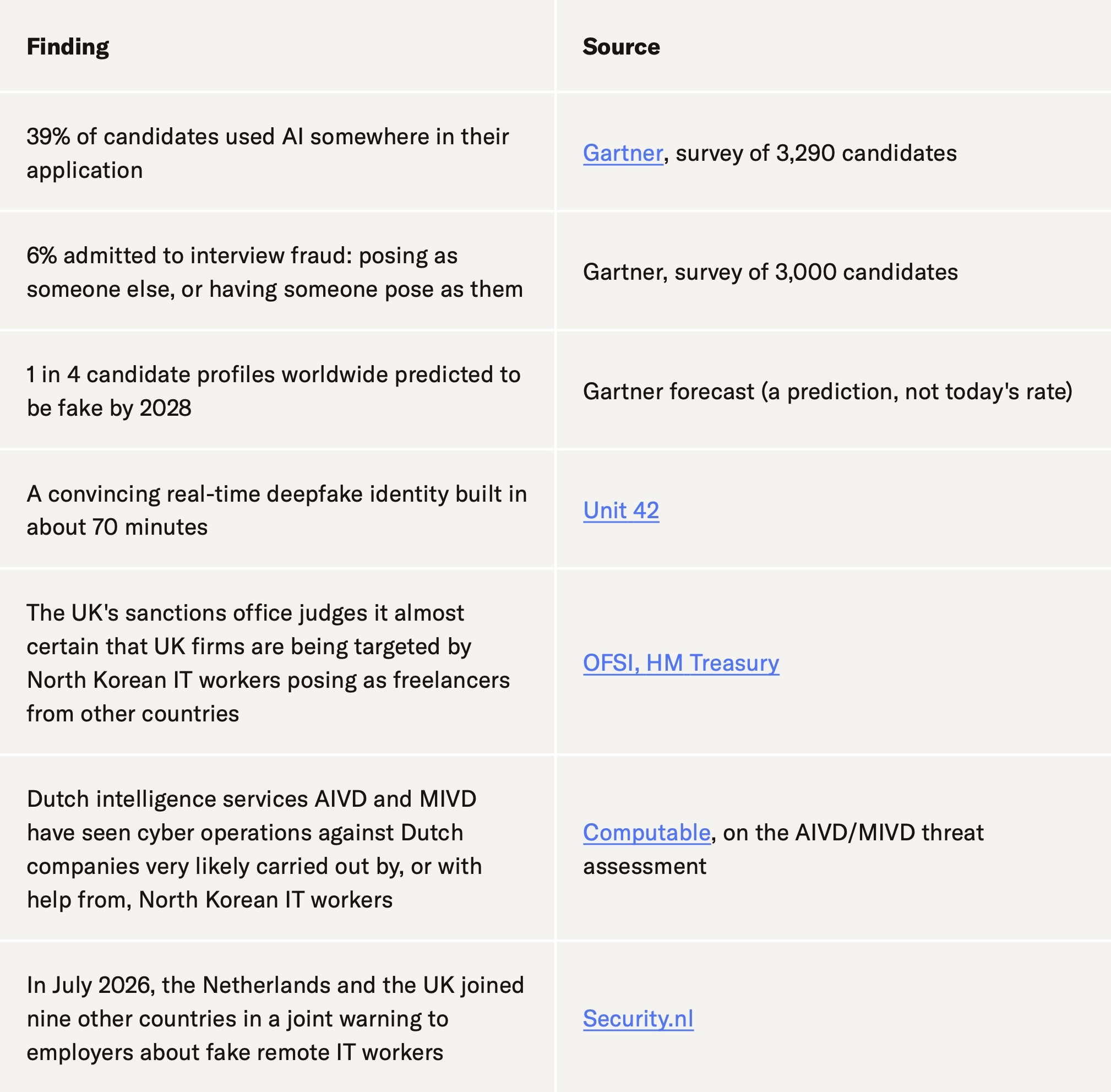
"Camera on" no longer proves who you're talking to. Real-time face-swap tools can put a different face over a live webcam feed, and they're free and easy to set up. Researchers at Palo Alto Networks' Unit 42 found that someone with no editing experience and an old computer could build a convincing fake interview identity in about 70 minutes (Unit 42).
What to watch for on camera
- Blurring, flickering or a "halo" around the edges of the face, hair or glasses
- Lips slightly out of sync with the voice
- Skin that looks too smooth, or lighting on the face that doesn't match the room
- A face that glitches or slips when the candidate moves quickly or touches it
- Camera "not working", a very low resolution feed, or a virtual background they won't switch off
- A voice that sounds flat, slightly robotic or doesn't match the person's apparent age
Simple live checks you can ask for, politely
- Ask them to pass a hand slowly in front of their face. Real-time deepfakes struggle to rebuild a partly covered face, and Unit 42 found this the most effective quick test.
- Ask them to turn their head fully to the side, then back.
- Ask them to hold their ID next to their face, if you've told them in advance this is part of your process.
Frame these as standard for everyone ("we do this with all remote candidates"), so genuine people don't feel accused. And treat them as a signal, not a verdict: deepfake tools are improving fast, and a clean result doesn't guarantee someone is real. Identity checks later in the process (see below) do the heavy lifting.
How seriously to take it
Take it seriously enough to change your process, not so seriously that you treat every applicant as a suspect. Here's what the evidence says.
Why it matters beyond a bad hire
- Security. The July 2026 joint warning says fake remote IT workers steal data, crypto and sensitive information from the companies that hire them. A common trick: an accomplice receives the company laptop at a local address and installs remote-access software, so the real worker can log in from abroad unnoticed (Security.nl).
- Sanctions and legal exposure. OFSI warns that employing or paying a North Korean IT worker, even unknowingly, can breach UK financial sanctions (OFSI). Dutch employers face the same risk under EU sanctions. That makes this a compliance problem, not just an HR one.
- Wasted time. Every fake candidate who reaches a final round has cost your team hours of interviews.
- Trust. Genuine candidates are wary too: only about half believe the jobs they apply for are real, per Gartner. Heavy-handed checks can push good people away.
The honest take: if you hire remotely for tech, engineering, data or finance roles, assume you will meet fraud attempts. If you hire mostly locally and in person, your main issue is AI-polished applications, not deepfakes.
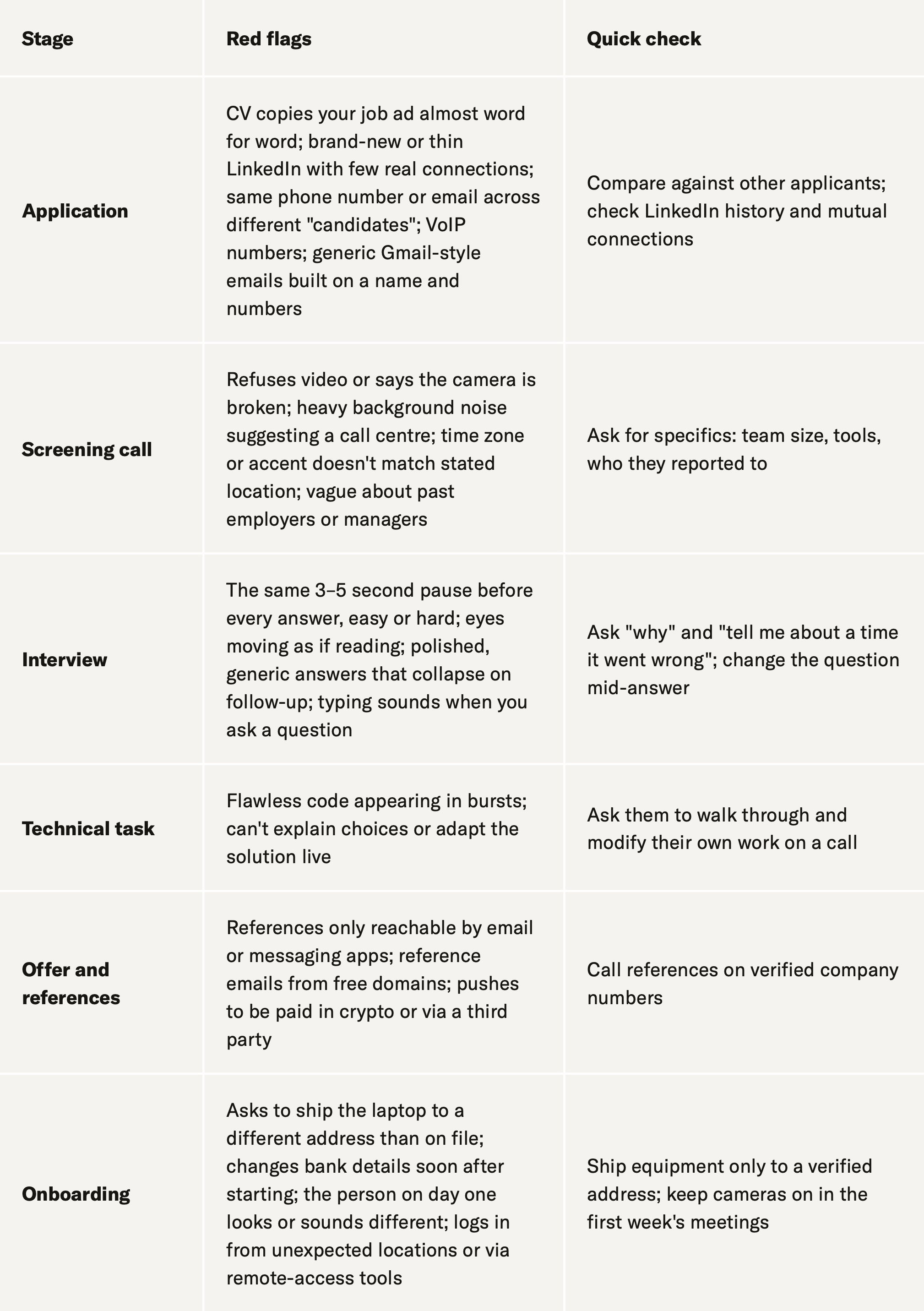
Red flags at each stage
No single flag proves fraud. Look for two or three together, and for stories that don't line up across stages.
Build a process that's hard to fake
The best defence isn't spotting deepfakes by eye. It's a process with a few checkpoints that a fraudster can't easily get through, and that a genuine candidate barely notices.
- Say it up front. In your job ad and invite emails, explain how you use video, what AI use is fine, and that you verify identity. This alone puts off a lot of opportunists.
- Ask questions AI can't prepare for. Go deep on their own CV: "What would you do differently on that project?" "Who disagreed with you, and why?" Follow up twice on every answer. Real experience holds up; scripted answers fall apart.
- Make technical tasks conversational. Have candidates talk you through their thinking, then change the requirements halfway. Review take-home work together live.
- Verify identity before the offer, not after. Use an ID check with a live selfie (liveness detection) at the final stage, and make sure the name on the ID matches the CV, references and payroll details. You already have to check ID: UK employers do right to work checks (digital checks through a certified identity service provider work well for remote hires), and Dutch employers must check an original ID document and keep a copy in payroll records under the identificatieplicht. Move that check before the offer instead of treating it as day-one admin, and keep only the ID data you need, in line with GDPR.
- Keep the same person throughout. Note who you met at each stage. If the voice, face or knowledge changes between rounds, pause.
- Meet in person when you can. For high-access roles, one in-person meeting, even a coffee in a co-working space near them, is still the strongest check there is.
- Check references properly. Find the referee's company number yourself and call through the switchboard.
- Close the onboarding gaps. Ship equipment only to a verified home address, flag bank detail changes in the first 90 days, and give new hires limited access until they've been around a while.
Keep it fair. Apply the same checks to everyone at the same stage. Don't single people out by nationality, accent or name. A shaky connection or a nervous candidate is not a red flag on its own.
AI use vs AI cheating: draw the line clearly
Using AI isn't the problem; hiding it, or using it to misrepresent who you are, is. Many of your best candidates will use AI to prepare, just as they'll use it on the job. Decide where your line is and tell candidates before they apply.

A short line you can adapt for your job ads:
We're happy for you to use AI to prepare your application. During interviews, we want to hear your own thinking, so please don't use AI tools live unless we invite you to. For remote roles, we'll verify your identity before making an offer.
What to do when something feels off
Stay calm, stay neutral, and verify before you accuse. You might be wrong, and if you're right, a confrontation only teaches the fraudster what to fix next time.
During the interview
- Keep going and ask more follow-up questions about their own experience.
- Use a standard live check (hand in front of the face, turn to the side) framed as routine.
- Make notes of exactly what you saw and when. Record only if you have consent and it's in your policy.
After the interview
- Compare notes with other interviewers, and check whether the same phone, email or CV details appear in other applications.
- Invite them to an identity check or an in-person meeting. Genuine candidates usually say yes; fraudsters tend to disappear.
- If you reject, keep it simple and factual. You don't need to explain your fraud checks.
If you've already hired them
- Bring in IT and security straight away. Limit or suspend access before you talk to the person.
- Involve legal or HR leadership before any formal step.
- If you suspect a false identity or links to a sanctioned state, report it:
- UK: report fraud via Report Fraud (England, Wales and Northern Ireland; in Scotland, Police Scotland on 101), and tell OFSI about a possible sanctions breach (see its advisory).
- Netherlands: file a report (aangifte) with the police, and ask your legal adviser about any sanctions implications.
Share what you learn. Tell your team and recruiter network what you've seen. Fraud patterns spread fast, and so should the warnings.
Watch the webinar
Want to see this in practice? Back in March, Homerun teamed up with Remote Crew for the webinar AI cheating in remote interviews (and how recruiters can detect it). Together we walked through real examples of AI-assisted and fraudulent candidates, the signals recruiters are spotting, and how to adapt remote interviews without hurting the candidate experience.


