

Why this is so hard to find out
Try to get a straight price out of an ATS vendor. Go on. Most of them won’t give you one until you’ve sat through two or three calls, and even then it arrives as a custom quote built around what they think
you’ll pay.
This isn’t an accident. Opaque pricing is a sales strategy. The longer they can keep you in the dark, the more they can anchor you to a number that suits them, not you.
Most vendors won’t list prices on their website either, and it’s the same logic. When your pricing model depends on implementation fees, per-seat charges, and premium support tiers, publishing a clean number would immediately expose how expensive you actually are. Hiding costs isn’t just a negotiation tactic; it’s structural. Homerun is an exception: our full pricing is at homerun.co/pricing, no quote required, no demo needed. We think every buyer deserves that transparency, regardless of which tool they end up choosing.
So we did the thing the vendors won’t. We pulled together real pricing across the ATS market, sticker prices, the costs they don’t put on the website, and what companies your size actually end up paying.
This guide is for the person doing the buying: usually a Head of People, Talent Lead, or whoever got handed the “go find us an ATS” project. It will not make you sit through a sales call to get a number.
One disclosure up front
We make an ATS (Homerun), so treat the numbers about us as coming from the source. The numbers about everyone else come from public pricing, customer - reported figures, and the kind of digging you'd do yourself if you had a free afternoon.
We've flagged where a number is an estimate.
The three price tiers
ATSes cluster into three pricing tiers. They're not better or worse than each other — they're priced for different sizes of company. The expensive mistake is buying out of your tier.
Tier 1 — Lightweight ATS
Roughly €100–€500/month, billed annually. All-in pricing.
Who: Homerun, Recruitee, Workable, Teamtailor (entry tier), Pinpoint.
Built for 50–300 people, hiring in one to three countries, with a hiring team of one to three. These teams typically make 15–60 hires per year. Setup is days, not months. Hiring managers actually log in and use them. What you pay is what you pay, the price on the page is close to the price you’ll be charged.
Tier 2 — Mid-market ATS
Roughly €15,000–€50,000/year. Usually per-seat, plus implementation.
Who: Greenhouse, Lever, SmartRecruiters, Personio (recruitment module).
Built for 150–1,000 people with a dedicated talent acquisition team, typically making 30–200 hires per year. Heavy customisation, deep reporting, structured-interview tooling. Implementation runs eight to
twelve weeks. The sticker is only the start, per-seat fees and add-ons stack up fast, and the contract is rarely the number you were first quoted.
Tier 3 — Enterprise HCM
€100,000+/year. Custom everything.
Who: Workday, SAP SuccessFactors, Oracle HCM.
Built for 1,000+ people, global, compliance-heavy, making hundreds of hires per year across multiple countries. Hiring is one module inside a full HR suite. Implementation takes six to eighteen months. If you re reading this guide, you are almost certainly not a Tier 3 buyer, and if a Tier 3 vendor is talking to you at 80 people, ask yourself why.
The trap
If you're between 50 and 300 people, you are a Tier 1 buyer. Tier 2 vendors will still pitch you, because their sales targets need you to be bigger than you are. They'll show you features you'll never use and call it "room to grow." Be polite, then go back to Tier 1.
The costs nobody puts on the website
Sticker price is the starting point, not the finish line. The real cost of an ATS in year one is built from everything stacked on top of it, and most of it won’t appear on the pricing page. Here’s what that looks like, in the rough order it’ll surprise you.
Implementation fees
A one-time charge to set the system up. Tier 1 tools usually charge nothing or a token amount. Tier 2 tools charge anywhere from €2,000 to €15,000, sometimes more, and sometimes they make it mandatory. Always ask if it's optional. Often it is, and they just don't mention that.
Per-seat and per-user fees
Some tools charge per recruiter seat. Some charge per hiring manager who needs access. The second model is the dangerous one — every time you give a hiring manager a login, the bill goes up, so teams
ration access, which defeats the point of buying the tool. Ask exactly who counts as a billable user.
Job board posting fees
A few ATS's charge per job posting pushed to external boards, or take a margin on sponsored posts. If you post a lot of roles, this adds up quietly. Ask whether posting to Indeed, LinkedIn, and the usual boards is included or metered.
Integration and API costs
"Yes, we integrate with [your HRIS]" can mean three very different things: a native integration that works out of the box, a Zapier connection you build and maintain yourself, or a custom development project you pay for. Always ask which one it is. The difference is thousands of euros and several weeks.
Support tier upgrades
The price you're quoted often includes the basic support tier — email only, 48-hour response. The tier with a phone number and a same-day SLA costs extra. If support matters to you (it will, in month two),
price the tier you'll actually need.
Your own team's time
The least-counted cost and often the biggest. Setup is typically 40–80 hours of internal time over four to eight weeks. Training hiring managers is at least half a day each. None of this is on an invoice, but it's real, and it's why a "quick" implementation that drags into month three is so expensive.
Why "€100/month" is rarely €100/month.
A tool advertised at €100/month looks like €1,200/year. Add a €6,000 implementation fee, €3,000 in per-seat upgrades as you add hiring managers, and 60 hours of your team's time at a loaded cost of ~€50/hour (€3,000), and year one is closer to €13,200 — eleven times the sticker.

What 50–300 fte teams actually pay
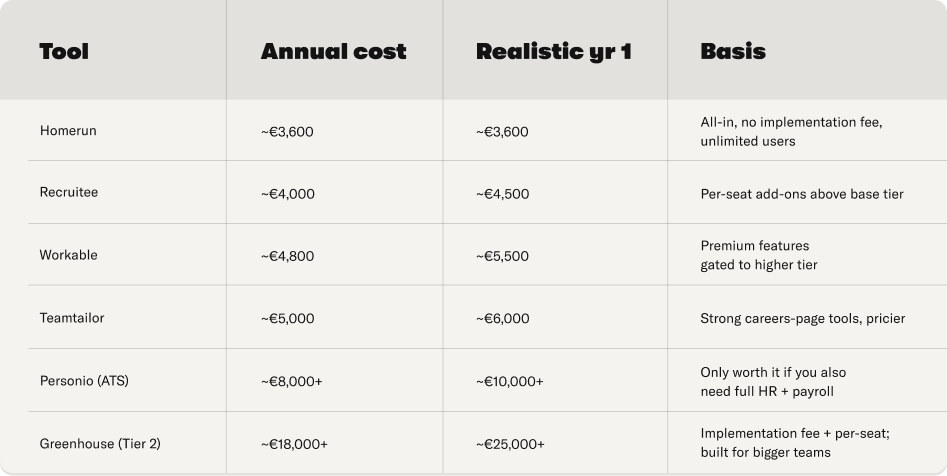
The sticker price is the number vendors lead with. It’s also the smallest number in this table. Everything else - implementation, per-seat fees, support upgrades, your team’s time stacks on top of it. The ‘Realistic yr 1’ column is what you’ll actually pay.
Approximate all-in year-one cost for a 75-person company hiring around 20 roles a year, with three hiring managers needing access. These are directional figures built from public pricing and customer-
reported numbers, use them to set expectations, then get exact quotes.
How to read this:
the gap between sticker and realistic year-one cost is the whole game. The tools where the two columns are close are the ones being transparent with you up front. Where the gap is wide, ask exactly what fills it, because you’ll be paying it either way.
The pricing questions to ask every vendor
Bring this list to every demo. Ask all of it. The answers and how comfortably they're given tell you more than the demo does.
- What's the exact all-in price for year one, for a company our size?
- Is there an implementation fee? Is it mandatory or optional?
- Who counts as a billable user, recruiters only, or every hiring manager too?
- Is posting to job boards included, or charged per posting?
- Which integrations are native, which are via Zapier, and which need custom development?
- What support tier is included in this price, and what does the next tier up cost?
- What happens to the price at renewal, locked, inflation-linked, or renegotiated?
- If we grow from 75 to 150 people next year, what does that do to the price?
The tell
If a vendor can't or won't give you a straight year-one number after one demo, that's information. The good Tier 1 vendors will tell you on the first call. The ones that need three calls to reveal a price are usually the ones whose price you won't like.
What's actually negotiable
More than vendors let on. A few things worth pushing on before you sign.
The implementation fee
Often the first thing to go. If you're a clean, motivated buyer ready to sign, many vendors will waive or halve the implementation fee to close the deal. Ask. The worst they say is no.
The renewal rate
This is the one most people forget and regret. Get the renewal terms in writing before you sign the first contract. A locked rate for 24 months, or a capped increase tied to inflation, is reasonable to ask for.
"We'll discuss it at renewal" means "we'll raise it at renewal."
Multi-year discounts
If you're confident, a two-year commitment usually unlocks 10–20% off. Only do this if you've done your homework — locking into the wrong tool for two years is worse than paying month-to-month for
the right one.
The contract exit terms
Check the auto-renewal clause. A 30-day notice window is tight; push for 60. And confirm you can export all your candidate data if you leave — you'd be surprised how many contracts are quiet on this.
When the cheapest ATS is the wrong one
This guide is about cost, so it's only fair to say: cost is not the only thing that matters, and optimizing purely for price will burn you in specific cases.
When your hiring managers won't adopt it
The cheapest tool that your hiring managers refuse to log into is the most expensive tool you can buy, because you end up doing all the work manually anyway. Adoption beats price. If a slightly more
expensive tool is one your team will actually use, it's cheaper in practice.
When you're about to scale fast
If you're 70 people today and genuinely hiring to 200 next year, buying the rock-bottom tool now means re-buying in eighteen months — and migrations are painful and expensive. Buy for where you'll
be in a year, not where you are today. (But be honest about your growth — most teams overestimate it.)
When the cheap tool nickel-and-dimes you
A low sticker price with per-seat fees, per-posting fees, and gated features can quietly cost more than a higher all-in price. This is why the realistic-year-one column matters more than the sticker. Cheap-looking is not the same as cheap.
The better question
The right frame isn't "what's the cheapest ATS." It's "what's the lowest total cost of ownership for a tool my team will actually use, at the size I'll be in a year." That question has a different answer than the price page.
One last thing
We wrote this because ATS pricing is deliberately murky and somebody should just say the numbers out loud. If it saved you a few sales calls, good.
On Homerun specifically: we're Tier 1, all-in pricing, no implementation fee, unlimited users. We're built for growing organizations with 50–300 employees in Europe. If that's you, we're worth one of your three demo slots. If you're heading past 500 employees or hiring globally, we'd point you to Greenhouse or Workday instead. We'd be the wrong tool, and we'd rather tell you now.
If you'd like to see where we land on your own version of the table above, book a 25-minute demo. We'll give you the exact year-one number on the call. No three-call runaround.
Ready to see the numbers?
See Homerun in action and get your exact year-one price. No implementation fee, no user limits, no three-call runaround.
.webp)
%20(6).webp)
.webp)