

What's the main difference between Homerun and Recruitee?
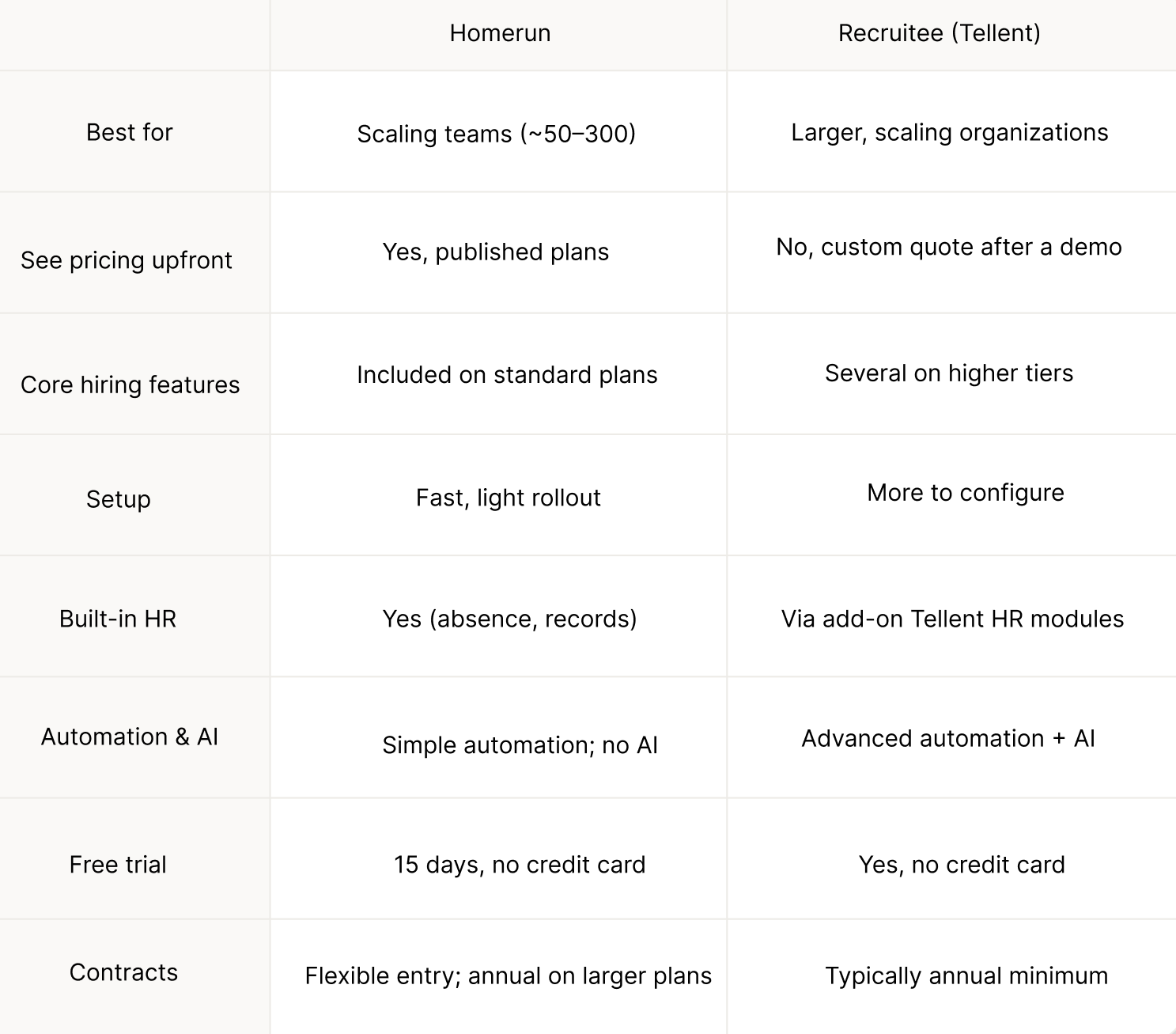
Homerun is a design-led ATS for scaling companies, while Recruitee is a more configurable platform aimed at larger, scaling organizations. Homerun focuses on ease of use, beautiful career pages, and transparent pricing, with the everyday hiring features included on its standard plans. Recruitee offers deeper workflow customization and advanced automation, with several features arriving on higher tiers.
Think of it as the difference between a tool a 50–300-person team can run smoothly without a big rollout, and a platform you configure to handle complex hiring across many departments, locations, and high volume. Neither is "better" in the abstract, it depends on how complex your hiring really is.
Is Homerun or Recruitee easier to use?
Homerun is generally the easier of the two to set up and run, especially for teams without a large recruiting operation. It's designed so hiring managers and people-ops generalists can post a job, build a career page, and review candidates without training. Recruitee is more powerful and more configurable, which also means there's more to learn and set up.
This is the heart of it. Homerun was built by designers with usability first, so a scaling team gets moving quickly. Recruitee's flexibility is genuinely valuable once your hiring gets complex or high-volume, but for many 50–300-person teams, that extra depth is more than the day-to-day actually needs 🤓
How do Homerun and Recruitee compare on career pages and candidate experience?
Both let you build branded, no-code career pages, but they emphasize different things. Homerun leans hard into design and candidate experience: highly brandable job posts and career pages, 15 languages, SEO, and Google for Jobs. Recruitee also offers strong, multi-page, multi-language career sites, with its focus more on supporting recruiting at scale.
If a polished employer brand and a great candidate experience are top priorities, and you want them without a heavy build, this is squarely Homerun's home turf. It's a big reason scaling teams pick it.
Which features are included, and which sit behind higher tiers?
With Homerun, the everyday hiring features a scaling team wants are included on its standard plans. With Recruitee, several of those same features are available only on higher tiers. And unlike Homerun, Recruitee doesn't publish its pricing, you'll need to book a demo to get a quote.

For a scaling team, this is the practical difference: with Homerun you get the essentials from the start, at a price you can see on the website. With Recruitee, the depth is real, but some features arrive only as you move up the tiers, and the price comes after a conversation with sales.
What about pricing and contracts?
Here the difference is clear-cut. Homerun publishes its pricing: flat plans starting at €29/mo, with larger teams adding seats or booking a demo for a tailored plan, and a 15-day free trial with no credit card required. Recruitee doesn't publish prices at all, pricing is quote-based, scaled to your employee count, usually with an annual commitment.
In fact, Homerun is one of the few hiring tools in this category that shows its prices on the website, most, including Recruitee, ask you to book a demo first. For a scaling team that wants to understand cost before talking to sales, that transparency is a real advantage. Recruitee's model fits larger organizations negotiating a tailored, scaled plan.
When is Recruitee the better choice?
Recruitee is the better fit when your hiring is genuinely complex or high-volume. If you're filling many roles at once across multiple departments or regions, need customizable approval workflows and advanced automation, or want built-in AI, SSO, and a clear path into a full HRIS, Recruitee is built for exactly that, and it's a strong choice as you scale well beyond 150 people.
We believe in honest advice, so we'll say it plainly: once hiring complexity outgrows what a focused tool covers, Recruitee's depth is a real strength. Homerun is designed to keep scaling teams fast and clear, which is an advantage right up until you need that heavier machinery.
Key takeaways
- Homerun = clear, easy-to-use, design-led, transparent pricing, with core features included. Best for sclaing teams of ~50–300.
- Recruitee = configurable, automated, scalable, with a route to full HR. Best for larger or highly complex hiring.
- Homerun's pricing is published; Recruitee's is quote-based after a demo.
- Features Recruitee keeps on higher tiers (scorecards, branded comms, screening questions, self-scheduling) come standard with Homerun.
- The right answer is mostly about complexity: scaling and clear → Homerun; large-scale and complex → Recruitee.
FAQ
Is Homerun or Recruitee better for a scaling company? For many scaling teams (around 50–300 employees), Homerun is the more natural fit, simple to roll out, core features included, and transparently priced. Recruitee is better suited to larger, scaling organizations with more complex hiring needs.
How much do Homerun and Recruitee cost? Homerun publishes plans starting at €29/mo, with larger teams adding seats or requesting a tailored plan, and a 15-day free trial. Recruitee doesn't publish prices; you request a quote after a demo, based on your employee count, typically on an annual plan.
Which features come included with Homerun vs Recruitee? Homerun includes interview scorecards, branded candidate communication, screening questions, and calendar-synced scheduling on its standard plans. Recruitee offers several of these on higher tiers. Recruitee does offer SSO and built-in AI, which Homerun doesn't.
Does Homerun have AI features like Recruitee? Recruitee advertises AI features such as AI writing and an AI screening assistant. Homerun doesn't currently promote AI features, it focuses on a clear, design-led experience. If AI-assisted screening is essential, that's a point in Recruitee's favor.
Can Homerun handle HR, not just hiring? Yes. Since merging with Staff Squared in 2025, Homerun offers a light HR module (Homerun HR) covering absence, employee records, calendars, and org charts, alongside the ATS. Recruitee offers HR through separate Tellent HR modules.
Does Homerun have a mobile app? Homerun is fully responsive and works on mobile via the browser, but it doesn't offer a dedicated native app. Recruitee does offer native iOS and Android apps.
.webp)
.webp)
%20(1).webp)